
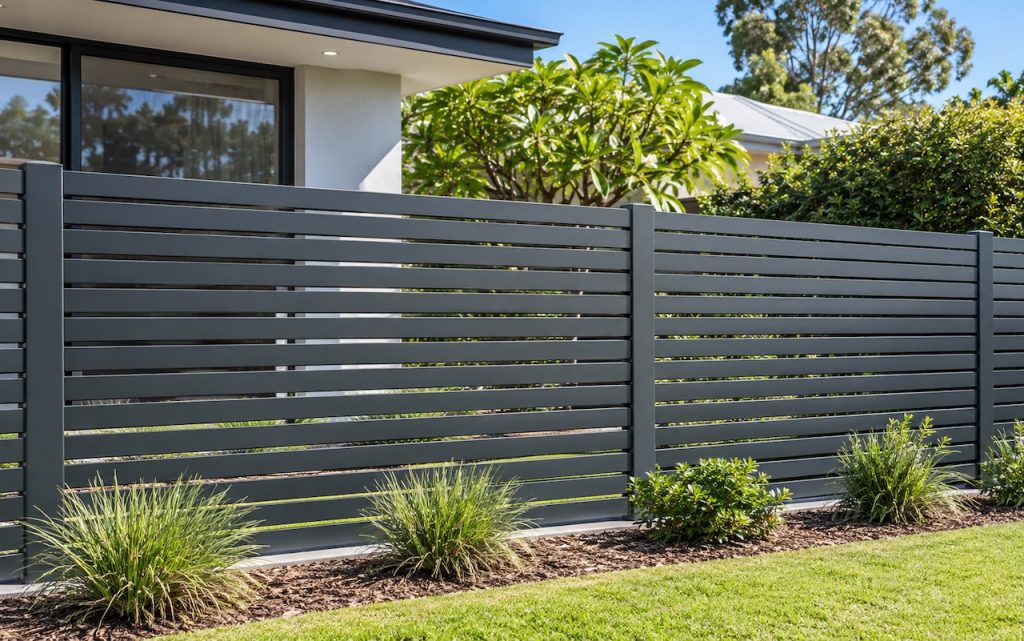
Aluminium slat fencing is a screen of horizontal 65 x 16mm aluminium slats fixed between 50 x 50mm posts, usually with concealed channels that hide every screw.
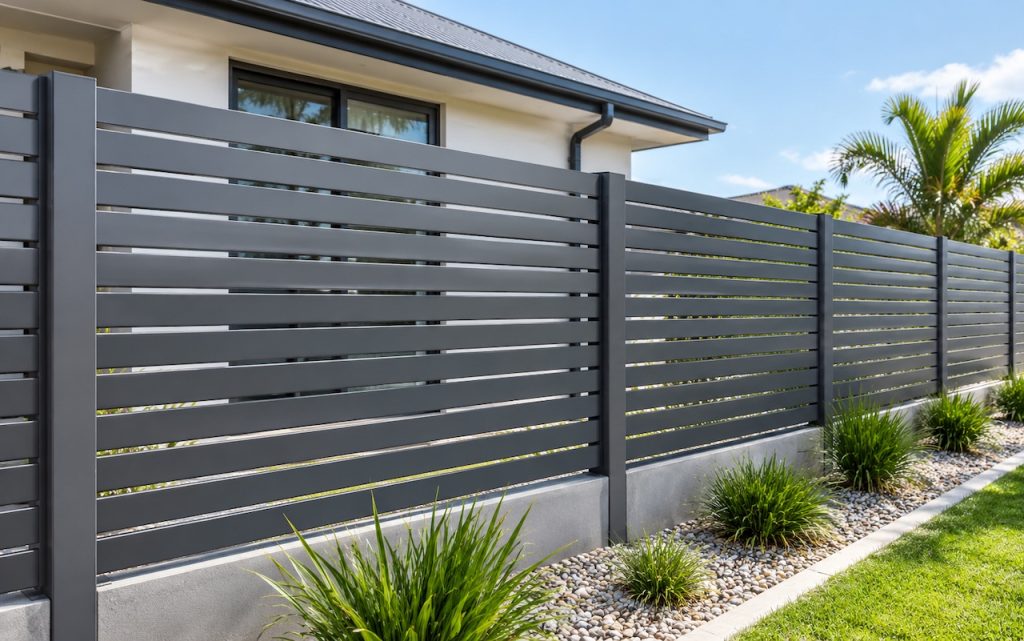
It won’t rot, warp or need painting, and a powder-coated finish matches the house. Buy A Length stocks the full Xcell slat system in about 38 colours, with slats, posts and channels cut to your exact sizes.
That means each bay arrives ready to assemble, with no 6.5m lengths to cut on site and no offcuts to pay for.
What parts make up an aluminium slat fence?
A slat fence or privacy screen is a kit of five main parts, plus fixings:
- Slats: Xcell 65 x 16 x 1.2mm rectangular hollow slats, cut to the width of each bay.
- Posts: Xcell 50 x 50mm posts with a 5mm wall, cut to height, plus corner posts where the screen turns.
- Concealed fixing channel: fixed up each post to hold the slat ends. Xcell concealed fixing channel.
- Concealed fixing cover: snaps over the channel to hide the screws. Xcell concealed fixing cover, finished with an end cap from around $5.
- Footings: 100 x 100mm pre-drilled base plates from around $23, with 75mm Dyno bolts for concrete, or posts set in the ground.
Finish the tops with 50 x 50mm post caps from around $19.
Planning a screen? Send us your measurements and we’ll help you build the parts list.
How does a concealed fixing channel work?
The channel is a U-shaped extrusion screwed up the face of each post. The slat ends sit inside it, so no screws go through the face of the slats.
Once the slats are in, the cover clips over the channel and hides the fixings. The result is a clean face on the slats and a clean edge on every post.
Cut each slat slightly shorter than the gap between the channels so it drops in without binding.
How many slats do you need?
Work it out bay by bay. Each 65mm slat plus its gap is one “course”.
- 10mm gap: 75mm per course, about 13 slats per metre of height.
- 20mm gap: 85mm per course, about 12 slats per metre of height.
Worked example: a 1,800mm high screen with 10mm gaps needs 1,800 ÷ 75 = 24 slats per bay. A screen with four 1,800mm wide bays needs 96 slats, each cut to the bay width.
Gaps of around 5 to 10mm give more privacy. Gaps of 20mm or more let through more breeze and light.
Want privacy and airflow together? Xcell 45 degree louvre slat brackets, from around $8 a pair, angle the slats so you can’t see through but air still moves.
How far apart should the posts be?
Shorter bays are stiffer. A 65 x 16mm slat flexes more the further it spans, so most concealed-fix screens keep posts no more than about 1,800 to 2,000mm apart.
For wide bays, a midrail insert stiffens the slats at mid-span. Plan post positions so every bay is the same width. Identical bays look better and mean one cut length for every slat.
In-ground posts or base plates?
Base plates suit concrete slabs, patios and paths. Bolt the 100 x 100mm plate down with 75mm Dyno bolts, then fix the post to it. There’s no digging, and the posts can come off later.
In-ground posts suit garden beds and boundary lines. Set the post in a concrete footing. It’s stiffer against wind than a base-plated post of the same size, but cut each post longer to allow for the depth in the ground.
Either way, remember a slat screen catches wind like a sail. The tighter the gaps, the more load goes into the posts and footings. For tall screens in exposed spots, ask a builder or engineer about footing size.
Why order slats cut to length?
Xcell slats come in 6.5m lengths. That’s too long for most trailers, and lengths that size often attract oversize freight charges. Ordering the slats cut to your bay width means:
- they arrive in shorter bundles that travel safely
- no cutting powder-coated aluminium on site, so no chipped edges or bare metal
- you pay for the aluminium in the fence, not for offcuts
Enter each length in millimetres at checkout. Use “+Add More” to order slats, posts, channels and covers in one go. Here’s how cut-to-length ordering works.
Ready to order? Browse every Xcell slat fencing component.
Which colour should you choose?
Xcell slats are stocked in about 38 finishes. Popular choices include:
- Monument and Textura Black: modern dark screens that recede into a garden
- Surfmist and Pearl White: light screens that match white trims
- Woodland Grey and Basalt: mid-tone greys that match COLORBOND® roofs
- Wood Effect: a timber look without the oiling, rot or splinters
Match the slats, posts, channels and covers to the same colour code, not just the same colour name. Our powder coat colour guide explains why.
Before you build: rules to check
- Height limits: councils set maximum heights for boundary fences and screens, and taller structures may need approval. Check with your local council first.
- Boundary fences: if the screen sits on a shared boundary, the dividing fence rules in your state may require you to agree it with your neighbour.
- Pools: horizontal slats can be climbed. A slat screen on its own isn’t a compliant pool barrier.
Frequently Asked Questions
What size are aluminium fence slats?
The most common size is 65 x 16mm. Buy A Length stocks Xcell 65 x 16 x 1.2mm rectangular hollow slats in 6.5m lengths, or cut to your exact size.
How many slats do I need for a 1.8m high fence?
With 65mm slats and 10mm gaps, you need 24 slats per bay for a 1,800mm high fence. Multiply by the number of bays.
What gap should I leave between fence slats?
Around 5 to 10mm for privacy, and 20mm or more for airflow and light. Louvre brackets angle the slats to give privacy and airflow together.
Can aluminium slat screens be installed on concrete?
Yes. Bolt 100 x 100mm base plates to the slab with masonry anchors such as 75mm Dyno bolts, then fix the posts to the plates.
Is aluminium slat fencing better than timber?
For low maintenance, yes. Powder-coated aluminium doesn’t rot, warp, split or need re-oiling, and it’s termite-proof. Timber costs less up front but needs ongoing upkeep.
Plan Your Slat Fence Today
Buy A Length has supplied aluminium to the Australian trade since 2006. The Xcell system gives you every slat fencing component in one place, cut to the millimetre, in about 38 colours, and dispatched within 1 to 2 business days.
Shop Xcell slat fencing, order slats in your colour, or call 1300 720 838 for help with your parts list.